
level designer
Starfield:
“oPERATION HAZEL”
mASTER’S THESIS
creation kit | 230hr dev. time | singleplayer
high-level design goal:
hostage-rescue gameplay that supports thesis research
OVERVIEW

The level takes the player aboard The Hazel, a star-station that is used to research plant growth in space. The ship is divided into four wings that are explorable in any order and pace.
The player’s goal is rescue 10 hostages trapped in the station by space pirates known as the Ecliptics.
My main design goal for this project - beyond supporting my research - was to create a level that embraced open-world design in a manner that led players to their objective in a natural way.
2d map
Design process
design techniques
With open-world design, strong conveyance is the difference between an enjoyable and frustrating experience.
I used these techniques to guide players to the 10 rooms where hostages were found:
Leading lines: Props and level geometry were set up to create implied lines that led the player.
Sightlines: Most hostages can be seen through a window that leads to their captive space.
Circular flow: I placed hostage rooms along the level’s critical path to increase the odds of the player encountering them.
Combat: Enemies encounters are designed to push the player towards the next area.
fEEDBACK OF PROGRESS
Hostages will gather in the Lobby (hub area) as they are saved.
Since this is an area the player must pass through repeatedly throughout the mission, this acts as visible feedback for their progress.
Combat design
While “Operation Hazel” is an exploration-focused level, I decided to include 4 combat encounters - including a boss fight - to chunk the experience so saving hostages didn’t become repetitive.
Boss fight:
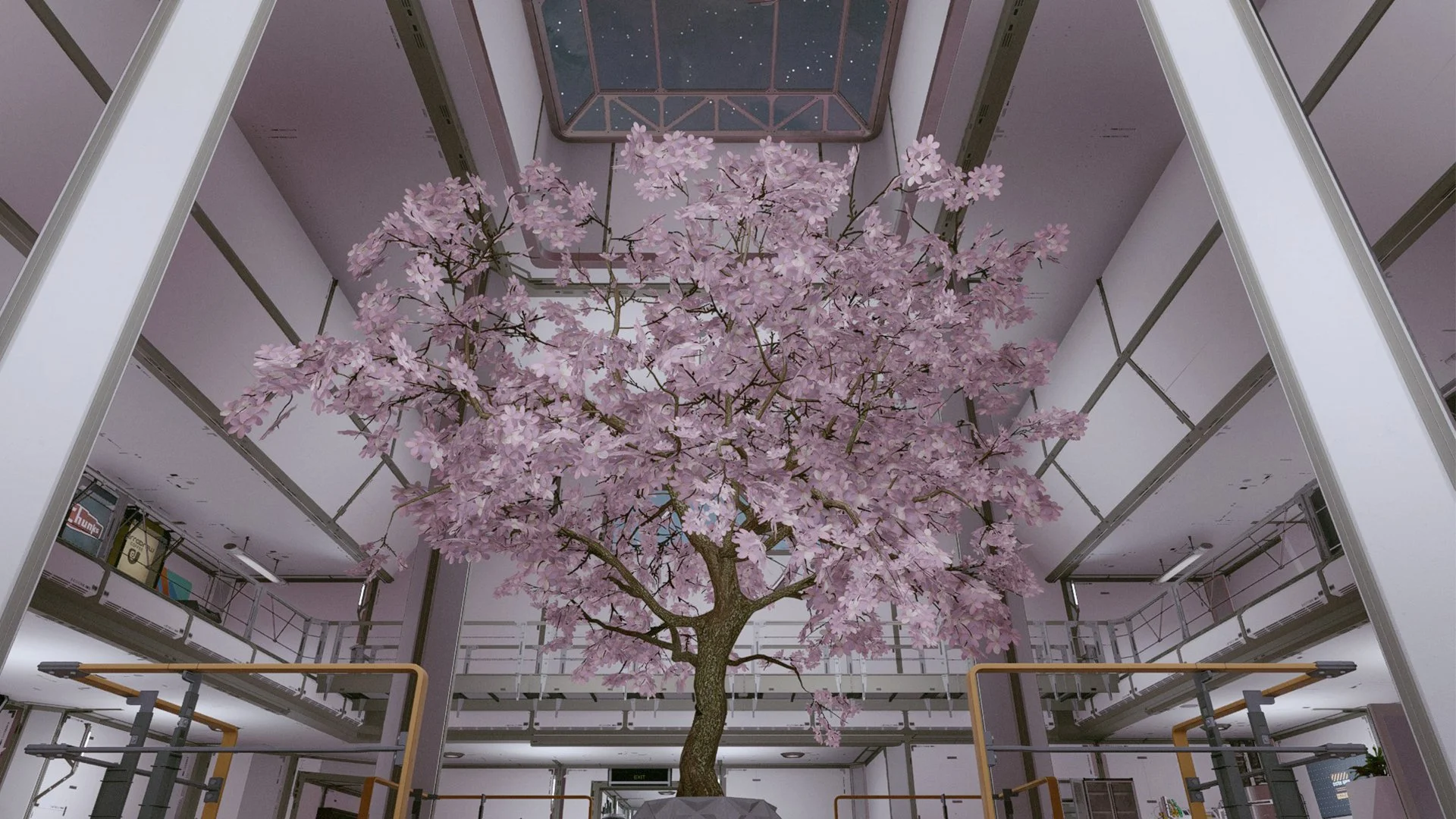
Setting: The finale takes place in the Atrium - a large glass dome with a view of the stars and a giant cherry blossom tree in the center.
Layout: The tree also serves as full cover for the encounter. Enemy movement encourage circling the around its trunk.
Enemy diversity: The fight includes enemies with melee, short-range, and long-range weaponry, creating a dynamic encounter.
Verticality: A long-range enemy on the high ground draws the player up there (which is where the final boss is eventually fought).
Leading lINES
SIGHTLINES
cIRCULAR fLOW
cOMBAT
gallery [[[TO DO]]]


postmortem
What Went Well
Design techniques: Sightlines, leading lines, and other conveyance elements were planned early in the paper-design phase. Forethought and early implementation allowed these techniques to shine in the final level.
Aesthetics: I am quite happy with how the final visuals came out. 92% of playtesters reported that they found the level aesthetically pleasing. Lighting and set dressing were the highlights.
Thesis support: Simply put, the level supported my thesis research (see next section!) to a satisfactory level. It hosted my test environment and output the data I was looking for.
What needs improvEMENT
Conveyance: A few playtesters still struggled with finding some hostages - I believe additional conveyance is needed. Color contrast is especially lacking (e.g., making the hostage room’s door bright red).
Boss fight: The boss fight shipped with some navigation bugs that I was unable to fix. Further testing would’ve been ideal.
Hostage-rescue: Many testers reported that the act of saving hostages was not engaging. Given more development time, I would add more interactivity and challenge to this mechanic.
Even Better If…
Accommodate for all playstyles: While not the goal of this project, having opportunities for players who enjoy stealth, hacking, etc. would increase enjoyability.
Further aesthetics passes: Time constraints regarding my research caused me to lose some development time during the polish phase, so some aesthetic features like decals and VFX are missing.
Thesis topic
My thesis, “Predicting Player Perception of a Room’s Purpose Through Context Complexity”, aimed to discover and quantify the minimum amount of information needed for a player to accurately understand an interior room’s fictional purpose.
In other words, I wanted to answer the question: “How much visual context does the player need to understand a room’s function?”
To answer this question, I collected predevelopment data that assigned numeric values to different props, textures, and room sizes.
I then created paper maps mathematically by adding objects/textures until a desired sum was reached - this sum was referred to as “Context Complexity”.
Once development concluded, I recruited playtesters to complete the level and give their opinion on what they believed each room to be.
Using this survey data, I proved…
That the minimum amount of contextual information can be quantified,
What this minimum value was (for my test conditions).
I then hopped into the editor to realize these paper designs. Here are a few examples of what the finished rooms looked like.
Note that some look pretty empty - this was intentional for my research (i.e., maybe a player only needs a single bed to realize the room is a bedroom).